Joseph Profaci

Joseph Profaci
Joseph Profaci

If the average crime family "godfather" is supposed to inspire respect, Joe Profaci, the longtime boss of the Brooklyn crime family, missed the boat.

There probably was not a boss hated by more of his own men than Profaci, precisely because he ran his outfit in the "approved" old Sicilian manner, requiring every member of the family to pay him monthly dues of $25. By contrast, in Buffalo old Stefano Magaddino dispensed family funds every Christmas until he got too penurious to do so in his old age, but Joe Profaci never had suffered any such failing of giving. He simply took and took. Carmine Persico Jr., who later became a successor to the leadership of the family, once complained about Profaci to Joe Valachi: "Even if we go hijack some trucks he taxes us. I paid up to $1,800."

In theory, the $25 monthly payments were to establish a slush fund to take care of legal fees, bribes and support payments to a soldier's family if he was imprisoned, but it was a custom long abolished in other crime families. Profaci, although a multimillionaire who lived in a huge mansion on a 328-acre estate on Long Island, which boasted a hunting lodge and its own private airport, just was not going to miss any stray penny.


Crime paid for Joe Profaci even if it did not pay as well as it should have for his soldiers. While it was true that all crime family bosses required their men to pay tribute to them in the form of a slice of whatever rackets they ran, it was supposed to be given with "affection" or as a "token of respect." Profaci leaned very hard on his men to get his, and he ruled with an iron hand, ordering the execution of anyone objecting to his methods. For years the streets of Brooklyn were dotted with the corpses of those not following Profaci's rules of the game.

The personal life of Profaci presented an entirely different picture of the crime boss. He has often been described as the most devout Catholic of the Mafia leaders, although there were those in the underworld, among them the Gallos and their followers, who said Profaci embraced religion most fervently after he developed cancer.

Profaci attended St. Bernadette's Catholic Church in Brooklyn and even had a private altar constructed in his basement so that mass could be celebrated at family gatherings by a priest who was a close friend of the Profacis. In 1949 a group of leading Italian Americans, including some priests, petitioned Pope Pius XII to confer a knighthood on Profaci, a "son of Sicily" who, they said, had become a benefactor to the Italian-American community.

Profaci was the leading importer of tomato paste and olive oil in the country, owned more than 20 other businesses and was known as the kindly employer of hundreds of fellow countrymen. These citizens also pointed out that Profaci was a most generous donor to many Catholic charities.

Profaci's dream of papal approval was shattered however when the Brooklyn district attorney, Miles McDonald, protested to the Vatican that Profaci was a leading racketeer, extortionist, murderer and Mafia leader.

But the rebuff did not dampen Profaci's desire to demonstrate his religious zeal—if in a somewhat murderous fashion. A young independent thief had the effrontery to steal a jeweled crown from St. Bernadette's. Profaci took it as an insult not only to the Lord but also to the godfather himself. He passed the word that the crown was to be returned forthwith or blood would flow.

The thief had no choice but to return the crown—no fence would dare handle it without the sure punishment of the mob. It was restored to the church, with a few of the jewels missing, and Profaci still ordered the death sentence. The thief was strangled with a rosary. Whatever Profaci's judgment would be in the hereafter, the incident did much to solidify his exalted position on earth, in the mob world, demonstrating how mighty his wrath could be.

Despite Profaci's ironfisted rule, he faced strong opposition within his family. The most determined opposition came from the Gallo brothers, who waged war against Profaci from 1960 until 1962 when Profaci died of cancer. The cause of the Gallo revolt was money—and the lack of it dispensed to their group by Profaci. The Gallos were willing and eager to be loyal to Profaci, a matter which they demonstrated when they killed a leading Brooklyn policy banker, Frank "Frankie Shots" Abbatemarco.

The Gallos and their top gunner, Joe Kelly, had worked for Frankie Shots for several years, but when Profaci ordered him killed, they eagerly complied. Frankie Shots's offense was to deny Profaci a $50,000 tribute, and the Gallos were promised a good portion of his racket for dispatching him. However, after the rubout, Profaci sort of forgot his promise and divided up the Shots's empire among his family and friends.

The Gallos joined forces with other dissidents, including Jiggs Forlano, a high-powered loan shark operator, and Carmine Persico Jr., originally a Gallo trainee. The anti-Profaci forces kidnapped several of the enemy and barely missed snatching Profaci himself, who was tipped off and fled to Florida where he checked into a hospital for safekeeping. The kidnappers figured to hold the Profaci men until the crime boss agreed to deal with them fairly.

Profaci secured the release of his men by making such promises and then split the enemy by promises of rewards to Forlano and Persico and some others if they would turn on the Gallos. The result was the bloody "mattress war" between the Profacis and the Gallos. The contest was still unresolved at Profaci's death.

If Profaci died hating the Gallos, that was nothing compared to his hatred for two fellow crime family godfathers, Carlo Gambino and Tommy "Three-Finger Brown" Lucchese. They like Profaci were members of the national commission and, noting the troubles in the Profaci family, "suggested" that Profaci "retire."

Profaci, not unjustifiably, saw the Gambino-Lucchese ploy as an attempt to take over the Profaci empire and refused. All-out war threatened until the leader of another Brooklyn crime family, Joe Bonanno, threatened to take up arms on Profaci's side if outsiders tried to depose him. Bonanno realized that if Profaci fell, Gambino and Lucchese would next turn on him.

Despite his many woes, Joe Profaci managed to die still in command of the crime family he had ruled for over three decades.

Mob style profiling

Mob style profiling
Mob style profiling

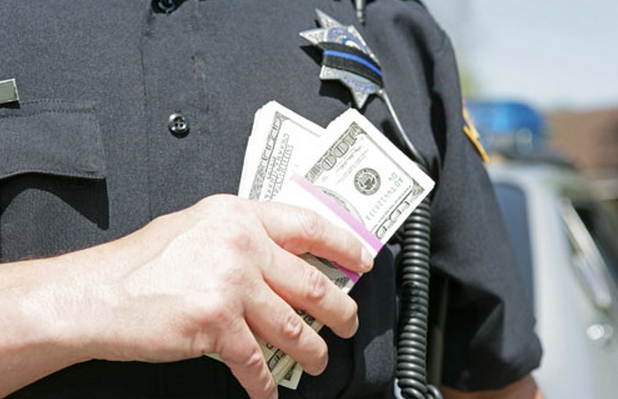
A custom today that has reinvigorated the mob is the mafioso ability to win support in the "right circles." For decades, starting with Prohibition and continuing thereafter, the mobsters learned the art and values of the payoff. The mobs always collected "right cops" in their rosters, ones who could do their bidding.

This "networking" of bribe takers has helped the resurgence of the mobs because of the trust inherent in the relationship between rogue officers and mobsters. With the flowering of "other Mafias" popularly thought to be determined to take over the weakened mobs, it created a dilemma for on-the-take officials. The code between wise guys and rogue officers was based on mutual trust, both parties needing the other.

Even as the mob came under severe pressure from law enforcement, the residue of goodwill between mobsters and rogues could not be eliminated. With ethnic bigotry coming into play, dishonest officers still felt comfortable only with the devils they previously knew. A dirty cop could trust a wise guy but never a member of the Russian Mafia, the Cuban or Colombian Mafias, Chinese Mafias or, indeed, any other ethnic group speaking languages they could not comprehend.


Any deals would have to be handled by longtime mob allies. This dynamic offered the traditional mafiosi the road to salvation, while dooming the emerging new mobsters to mere second-string roles. This mob-style "profiling" has become an important practice in the world of crime.

One of the more striking forms of criminal profiling involves the so-called Black Mafia. Rogue cops have long dealt with black racketeers for whom protection could be available at a price—a rather stiff price. Blacks today rant about what they call "Jim Crow racketeers." They can pay the cops directly or through the mob.

The latter method on a dollar and cents basis is superior because the protection comes cheaper through the Mafia. Of course, there is a markup for the mob, but still the price is less for black racketeers. The blacks take the deal but still are resentful that they are victims of this special form of racial profiling. Profiling thus has become a lucrative source of profit for the real Mafia.

Prohibition

Prohibition
Prohibition

The greatest day for organized crime in America was January 16, 1920, the day the Eighteenth Amendment went into effect. Prohibition descended on the land and so did a new criminal influence that was to fester, thrive and corrupt long after Repeal in 1933.

The proponents of Prohibition saw in their legislation the cure for all the social ills in America. Instead it produced new ills without getting rid of the old. Law enforcement agencies, hardly pristine over the preceding 70 or 80 years since they first were established, were seduced by bribes as never before. In the end, Prohibition was the mother of organized crime.

The great street gangs of America—born in the 1820s and 1830s and operated up to World War I— functioned in two chief fields: committing various forms of violent crime; and acting as bully boys or enforcers for the political machines of the big cities.


But by 1914 the gangs were in turmoil. In New York, the 1,500-member Eastman Gang was falling apart, their leader out of action behind bars. The Eastmans' arch rivals, the mostly Italian Five Pointers, were scattering. Their leader, Paul Kelly, reading the new morality of reform correctly, understood that an enlightened public would not much longer tolerate gang violence in elections, and he deserted his cohorts, moving into relatively minor labor racketeering activities.

Even that old reliable, prostitution, a leading gang activity, was hitting hard times. Reformers were everywhere. Then, during World War I, the federal government shuttered many of the country's most infamous vice centers—especially those in Chicago, New Orleans and San Francisco.

Immediately after the close of the Great War it happily appeared that the era of the great gangs was over. But Prohibition in one fervent swoop threw society's natural social development into chaos. Across the country 200,000 speakeasies sprang up and large bootlegging organizations were required to supply their needs.

Gang criminals, having gone straight out of sheer necessity, returned to their organizations. In New York alone, 15,000 saloons were closed by Prohibition, and 32,000 speakeasies came into existence. The owners of every one of these joints was breaking the law and paying bribes to remain in business. New York became a city on the take, the United States a country doing the same.

Bootleggers and rum-runners brought in booze from outside the borders, using brawn and bullets if bribes didn't work. The production of alcohol became a cottage industry in many towns, especially in the Little Italies of major cities, producing foul odors that lay heavy over entire neighborhoods. Since these odors were readily identifiable and the police did nothing to intervene, the police were branded, as never before, as obviously corrupt.

The Jewish Purple Gang of Detroit, till then more dedicated to spectacular robberies and murders, became one of the most important and deadly Prohibition gangs, controlling much of the liquor supply smuggled in from Canada. In Cleveland, the violent Mayfield Road Gang emerged as an extremely potent force, and of course, Chicago's Al Capone gained recognition as the country's most infamous gangster. It was estimated that Capone himself made some $60 million from bootlegging and rum-running.

In New York, the Broadway Mob—controlled by Lucky Luciano, Meyer Lansky, Frank Costello, Joe Adonis and Bugsy Siegel—was taking in about $12 million a year just from booze. In their operation they had about 100 men on the payroll—drivers, bookkeepers, enforcers, guards, messengers and even fingermen (to look for liquor shipments by other gangsters that they could hijack).

In an era when a department store clerk made perhaps $25 a week, most of Luciano's men were drawing a base salary of at least $200 a week. This gave the operation a payroll overhead somewhere over $1 million annually and left $11 million out of which they had to cover all expenses—mainly supplies and graft. "Grease" alone exceeded $100,000 a week.

Ten thousand of this, according to Luciano, went to top police brass, but that represented only a small part of the payoffs. All the precincts had to be taken care of—their captains, lieutenants and sergeants, all the way down to cops on the beat. After all costs, the combination still came out with $4 million or so in pure profits.

These Prohibition criminals had all begun as mere ghetto criminals, fresh from the source of most violent crime in any metropolis. In the 19th century an Irish ghetto criminal might call it a good day if he cracked a citizen's skull and walked off with $10 for his efforts. But these later ghetto criminals struck it rich thanks to the accident of Prohibition.

They were mostly Jews and Italians—those were the ethnic groups that had taken over the ghettos—but their great wealth was to raise them above the level of mindless street marauders as their ghetto predecessors had been and their ghetto successors would be. They had gone beyond organized ghetto crime to organized syndicate crime. Unlike earlier criminals who were bought by the politicians, they accumulated so much wealth that they reversed things and bought the politicians.

Disrespect for law grew as it became fashionable for even the most respectable citizens to serve bootleg liquor in their homes and visit lavish speakeasies. In the White House, President Warren G. Harding paid lip service to the dry movement and turned the nation's first residence into a private saloon. Most Prohibition agents themselves violated the law and took enormous bribes. Many ran their own bootleg operations.

The Treasury Department between 1920 and 1928 fired 706 agents and prosecuted another 257 for taking bribes. Nobody claimed they got all the crooks. Top T-man Elmer L. Irey described the agents as a "most extraordinary collection of political hacks, hangers-on and passing highwaymen." In New York, an angry and frustrated Captain Daniel Chapin ordered a lineup of all agents and declared, "Now everyone of you sons of bitches with a diamond ring is fired." Half were.

Finally, when the Democrats won the White House and the Congress in 1932, Prohibition was doomed. The Twenty-First Amendment killed it off in 1933. It did not kill off the great Prohibition gangs; they and various Mafia crime families rich with loot remained in business. The national crime syndicate was formed. The mobsters, now well connected with the political and police world, were a group that wanted to continue to feed at the trough themselves.

In the end, Prohibition gave birth to and nurtured organized crime and did such a brilliant job that today we still can't get rid of syndicated gangsters.

New Mafia rackets in Prostitution

New Mafia rackets in Prostitution

By and large, since the conviction of Lucky Luciano for compulsory prostitution in 1936, the East Coast Mafia has managed to stay clear of convictions for such charges. Luciano was convicted by then–racket buster Thomas E. Dewey for 30 to 50 years, which was a far tougher sentence than had ever been handed out for such a charge.

The eastern mobs howled it was a "bum rap," one handed to Dewey in a frame-up with the perjured testimony of pimps and prostitutes who would say anything to avoid going to jail. To some it was doubtful that Luciano, with the money pouring in from many other rackets, would bother with such "small potatoes" as commercial sex.

This was not a racket ignored in Mafia strongholds such as Capone's Chicago and Ohio, West Virginia and western Pennsylvania, but the New York godfathers kept their men out of such rackets, mainly on the basis that some political elements, in the pocket for the mob, did not want to provoke reform elements against them. Again, it was a case of more important financial fish to fry. Furthermore, practitioners of the sex racket were likely to crack under the pressure and be eager to surrender bigger mafiosi for a way out for themselves.


During the height of the so-called sexual revolution, the New York mobsters insisted they had followed the right course, since "too many broads were giving it away for free and you can't make money out of that." But the attitudes of the eastern mobs changed as law enforcement cracked down hard on Mafia activities.

During this period the other ethnic organized crime gangs pushed hard into new territories, with the Vietnamese, the Chinese and to a lesser extent the Russians and Koreans branching into first massage parlors and then lap dancing clubs and so on. The wise guys saw promise here and got in as well.

But the big money in prostitution remained the independent hooker rings that handled outcall services to customer's homes or hotel rooms. The payoff was much greater, anywhere from $100 to $250, or more. In their need for more revenues the Mafia went into the upscale outcall, or "escort," services.

A breakthrough in this end of the business may have come in April 2004 when a joint New York Organized Crime Task Force, the police department, and the FBI looked into the illegal gambling activities of the Gambino crime family on Staten Island. They wiretapped a social club on Fingerboard Road and noticed some known leaders in the sex racket visiting there.

Trailing these individuals they uncovered a series of corporate fronts and escort services with such names as Gentlemen's Delight, Day Dreams and Personal Touch that charged customers $250 for sex. The outfits were said to send out 15 to 20 limousine drivers to dispatch 30 to 40 prostitutes each day. Billings were done by merchant accounts held by escort services or limousine companies and in one case by a company that hired musical bands for weddings.

The task forces arrested 16 people on charges of enterprise corruption and two others for falsifying business records and promoting prostitution and money laundering, activities of interest especially to the mobs. The media saw this as more than a simple sex business but an important field for the mobs, their gambling and other activities. The new Mafia saw the broad field of paid sex as becoming a major profit center in the 21st century.

Anthony “Tony Pro” Provenzano

A prime suspect in the disappearance and almost certain murder of former Teamsters union president Jimmy Hoffa, Anthony Provenzano, often referred to as Tony Pro, had strong organized crime support from the start of his career in labor. One of Tony Pro's early sponsors was Tony Bender, a longtime associate of Vito Genovese who controlled much of the rackets along the New York and New Jersey waterfronts and, in connection with these, ran a number of Teamsters locals as well.

Provenzano was installed as a shop steward in a trucking company in 1945, and, by 1950, Bender had moved him along to become organizer for Teamsters local 560 in Union City, New Jersey. Bender was known to have used longshoremen to smuggle heroin into the country, and federal authorities long believed that Provenzano was deeply involved in narcotics trafficking.

Over the next several years Provenzano's rise continued in the Teamsters; he became president of Local 560 and a vice president of the International. Even when Tony Bender disappeared permanently— undoubtedly killed by order of Vito Genovese, behind bars at Atlanta penitentiary—Tony Pro had a clear run. He had become very important both to the mob and his local; others he controlled became the hubs of various organized crime activities.

Tony Pro oversaw bookmaking, numbers and loan shark activities run by his business agents and shop stewards. Even more lucrative was the widespread, often blatant pilferage of cargoes being trucked through New Jersey. Without a pass from Tony Pro no shipment could be considered "safe," and the price was not cheap.


This was demonstrated by the successful prosecution and 1966 conviction of Provenzano for extorting $17,000 from a trucking company. One of the witnesses slated to testify against Tony Pro had been Walter Glockner but he was gunned down and killed. Still, there was enough evidence against Tony Pro; he was sent to Lewisburg federal penitentiary in Pennsylvania where he did four and a half years.

In the prison he served as a prison capo under the boss of that institution, mob leader Carmine Galante. It cannot be said that Provenzano had a hard time there, being more or less in charge of assigning cons to some of the prison jobs. Informer Vinnie Teresa, upset at the 15 minutes of daily backbreaking labor spent cleaning a yard area about 10 by 20 feet, told Provenzano he wanted something easier.

Provenzano assigned him to radio duty. His work each morning before breakfast consisted of pressing a button that turned on the radios in the cells throughout the prison. That finished the work for the day. Tony Pro assigned someone else to turn the radios off at night.

When Provenzano finished his term he returned to his union duties, where no major opposition now existed. Back in the late 1950s and early 1960s there had been some opposition, but the rebels were seriously injured on two occasions, and several were targets of bombings and shotgun blasts.

The last important opposition to Tony Pro was Anthony Castellito, secretary-treasurer of Local 560, who announced plans in 1961 to compete against the mob leader for the presidency. That June after a union meeting, Castellito, like Jimmy Hoffa later, was seen getting into an automobile—and seen no more. In 1975 Hoffa disappeared.

After his release from prison in 1971 Hoffa announced plans to recapture the Teamsters union presidency from Frank Fitzsimmons, a leader with whom the underworld had become most comfortable.

The mob had little interest in Hoffa's return since he would probably be more demanding in dealing with them. Provenzano, as the man in the East Coast Teamsters, was said to have warned Hoffa to go away on a number of occasions. It has been a police theory since Hoffa's disappearance that it was Tony Pro who ordered his abduction and secret execution. The charge has never been proved.

In the meantime, charges were brought against Provenzano that he had ordered Harold Konigsberg, a longtime enforcer in the Genovese crime family, and Salvatore Briguglio to kill the long-missing Anthony Castellito. (Briguglio was also a prime suspect in the Hoffa case.)

On March 21, 1978, Briguglio, suspected of being a talker to the FBI, was shot on a New York street. Tony Pro was convicted after trial in Kingston, New York, in the Castellito matter. Both he and Konigsberg were sentenced to life imprisonment. Tony Pro died in prison of a heart attack at the age of 71.

Public enemies

Public enemies
Public enemies

When the average person is asked to name the most famous "public enemies" in the world of crime, the names he mentions are Dillinger, Bonnie and Clyde, Machine Gun Kelly, Ma Barker and the like. Among this group, despite the constant raging against them by the FBI's J. Edgar Hoover, Machine Gun Kelly never fired his weapon at anyone and Ma Barker was never so much as charged with a crime.

The press-conscious Hoover stole the idea from others and launched a publicity campaign in the early 1930s to dub a group of criminals, mostly little more than armed stickup men, the Public Enemies. At the time, Prohibition was ending and the old bootleg mobs were forming the new nationwide criminal syndicate. Apparently fearful and certainly uninterested in tangling with such major mobsters, Hoover concentrated his wrath on minor criminals, cloaking them in the mantle of master criminal.

For instance, while John Dillinger killed at most one person and his gang about nine others, Al Capone in Chicago was responsible for no less than 500 to as many as 1,000 murders. Had the full energies of Hoover's agency been turned on the major menace of the Capone-Luciano-Lansky organizations, it has been argued by many crime experts, organized crime today would be far less effective and pervasive, if not totally eliminated.


The first use of the term public enemies, before it was appropriated by Hoover, was made by Frank J. Loesch, a venerable corporation counsel and civic leader in Chicago and a founding member and longtime head of the Chicago Crime Commission.

He compiled a first list of 28 Chicago public enemies— "persons who are constantly in conflict with the law"—in an effort to counter the romantic aura with which certain elements of the most sensational press of the city and nation had endowed gangsters. Loesch's list included
  1. Al Capone
  2. Tony "Mops" Volpe
  3. Ralph Capone
  4. Frankie Rio
  5. Jack "Machine Gun" McGurn
  6. James Belcastro
  7. Rocco Fanelli
  8. Lawrence "Dago Lawrence" Mangano
  9. Jack Zuta
  10. Jake Guzik
  11. Frank Diamond
  12. George "Bugs" Moran
  13. Joe Aiello
  14. Edward "Spike" O'Donnell
  15. Joe "Polock Joe" Saltis
  16. Frank McErlane
  17. Vincent McErlane
  18. William Neimoth
  19. Danny Stanton
  20. Myles O'Donnell
  21. Frank Lake
  22. Terry Druggan
  23. William "Klondike" O'Donnell
  24. George "Red" Barker
  25. William "Three-Fingered Jack" White
  26. Joseph "Peppy" Genero
  27. Lee Mongoven
  28. James "Fur" Sammons
Almost any member of this list would make Hoover's "public enemies" look like boy scouts.

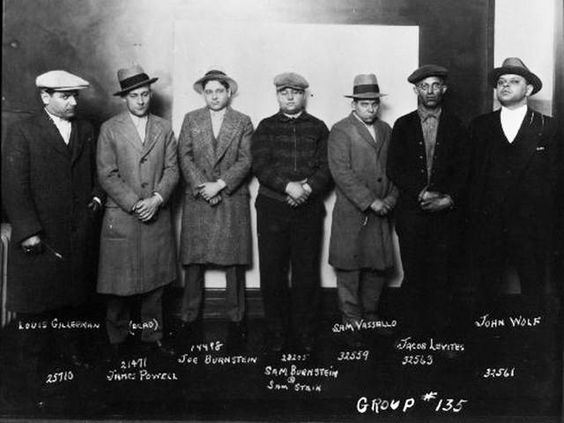
Purple Gang

Purple Gang
Purple Gang

One of the most feared bootlegging mobs during Prohibition, the Detroit Purple Gang was basically an all-Jewish outfit. The gang dominated the city's criminal activities and was responsible for at least 500 killings—a record that, proportionally speaking, exceeded the tally of the Capone mob in Chicago.

Its leaders, Benny and Joe Bernstein and Harry and Louis Fleisher, maintained close ties to the Cleveland Syndicate and such stalwarts as Moe Dalitz and Chuck Polizzi. Detroit was a pivotal importance during Prohibition because it served as a funnel for illegal booze shipped across the border from Canada.

The Purples engaged in competition with another mob, the Little Jewish Navy, and to aid them in their killings, they imported Yonnie Licavoli and his gunners from St. Louis. Licavoli and his brothers, cousins and friends in time formed what would be called the Licavoli family of the Mafia in Detroit.


Licavoli did not ever challenge the authority of the Purples, whose other gunmen were considered so proficient that, according to a leading theory, three of them—George Lewis and brothers Phil and Harry Keywell—were borrowed by Al Capone to help carry out the St. Valentine's Day Massacre in 1929. The Purples did not limit themselves to booze running, but accumulated additional millions in jewelry robberies, hijacking and extortion. They were also involved in drugs and were one of the prime suppliers to jazz musicians of the 1920s.

When the national crime syndicate was formed in the 1930s under the aegis of Lucky Luciano and Meyer Lansky, the Purples were invited to join. No coercion was used—the gang was considered too bloody and powerful to be subjected to force. However, the Purples accepted, disbanded their own organization and took an important role in the crime cartel's far-flung gambling activities, often providing any "muscle" that was needed.

The name of the Purple Gang was too colorful to be allowed to die, and years later any really tough character from Detroit was quickly labeled by the press as being a member of the Purple Gang.