John Patrick O'Brien

Following the resignation of the corrupt if charming Jimmy Walker, John P. O’Brien was elected to serve out the remaining year of the mayoral term. It was a stunning victory for organized crime.

O’Brien, known for his mediocre talents as a surrogate court judge and his unswerving loyalty to Tammany Hall, was clearly under the thumb of two Tammany leaders, James J. Hines (then controlled by mobster Dutch Schultz, a member of the new Luciano-Lansky national crime syndicate) and Albert C. Marinelli (then directly dominated by Lucky Luciano). When reporters inquired if the mayor was going to name a new police commissioner, he said, “I haven’t had any word on that yet.”

In 1933, O’Brien was succeeded by Fiorello La Guardia, and underworld payoffs to the police commissioner’s office—during the reign of the supposedly reputable Grover Whalen it came to $20,000 a week delivered in a plain brown bag— ceased.

Under La Guardia’s first police commissioner, Major General John J. O’Ryan, who served briefly, and the incorruptible Lewis J. Valentine, who held the post for almost 11 years, the police department was to have its longest run of honesty in the city’s history.

O’Cconnor's Gunners

O’Cconnor's Gunners

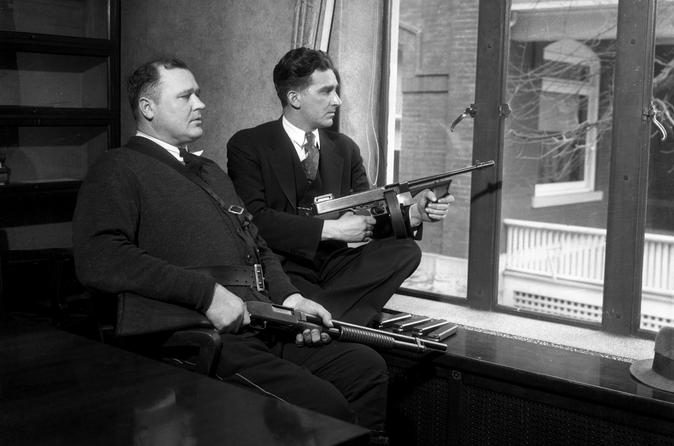
In 1927, William O’Connor, the new chief of detectives in Chicago, went out on a limb. Gang wars were terrorizing the city, but the press and his constituents were unconvinced that O’Connor could stop the shooting.

What the situation called for, Chief O’Connor decided—and convinced corrupt Mayor Big Bill Thompson was necessary—was an elite unit, an armored car force that could match the gangsters bullet for bullet.

O’Connor picked volunteers from the police force who had fought in the war in Europe and could handle a machine gun. To this squad of super-armed men, he issued an order of almost unparalleled irresponsibility:
Men, the war is on. We’ve got to show that society and the police department, and not a bunch of dirty rats, are running this town. It is the wish of the people of Chicago that you hunt these criminals down and kill them without mercy. Your cars are equipped with machine guns and you will meet the enemies of society on equal terms. See to it that they don’t have you pushing up daisies. Make them push up daisies. Shoot first and shoot to kill. If you kill a notorious feudist, you will get a handsome reward and win promotion. If you meet a car containing bandits, pursue them and fire. When I arrive on the scene, my hopes will be fulfilled if you have shot off the top of their car and killed every criminal inside it.


There was considerable hesitation by many persons to accept such a shoot-first-think-afterward program; they worried about innocent bystanders being cut down in the crossfire.

However, such worries by members of the public—and, perhaps, by the gangsters themselves—proved unnecessary. O’Connor’s Gunners turned out to be regular johnnies-comelately to crime scenes, hardly ever turning up in the right place at the right time.

Odessa by the Sea


While there is real doubt that a true “Russian Mafia” exists in America, popular belief is that the Brighton Beach section of Brooklyn is the capital of the most important “other Mafia” now functioning in the United States.

There is no doubt that the area is the center of much violence and brutality, at times said to rival the worst activities of the Mafia in Brighton Beach and Coney Island in its earlier days. It has been estimated that many thousands of illegal immigrants have entered the United States in recent years from the former Soviet Union under a grant of refugee status as politically oppressed people.

Many Brighton Beach inhabitants have come from Odessa and surrounding areas. The Black Sea port of Odessa has a long history of criminality, dating back to the days of the early czars and the pirates who ravaged the waters.


Thus Odessa was long a thriving black market and developed a centuries-old criminal subculture. Although most residents of Brighton Beach are clearly law-abiding, they have been tarred as the Odessukuya, or Odessa Thieves, often described in the motherland as the worst of all Russian criminals.

According to federal authorities, many of these illegals have come out of Soviet prisons, obtained identifications of dead or imprisoned Soviet Jews and used them to reach the United States, often muddying their trails by first immigrating to Israel.

This “shuttle plan” is similar to one used by Italian mafiosi early in the 20th century, who traveled first to North Africa and then on to the American land of opportunity, their criminal backgrounds lost in the shuffle.

Other Mafias


It has proven to be a fairy tale: a slew of other Mafiastyle ethnic gangs and organizations primed to succeed the Mafia as the new bosses of organized crime in America. The fairy tale falls apart for two reasons:
  1. The Mafia is far from dead and 
  2. except in isolated sections where law enforcement agencies have a particularly vexing problem with certain limited crime activity, most investigative forces tend to shrug off the idea of so-called new Mafias. 

In 2003 the The New York Times, some might say belatedly, came to the conclusion that the old Mafia persists while at the same time “other bands of ethnic criminals come and go.”

Many examples of the decline and fall of “other Mafias” are offered in the preface, highlighting the rise and decline of so many of these supposedly “comer” crime families. Suffice it to note here merely a couple: the Cuban Mafia, as offered by Hollywood in the resurrected version of Scarface pointing implicitly to the seeds of that element’s destruction; or to the Russian Mafia, a.k.a. the Russian-Jewish Mafia, which has forever “got no respect” by law enforcement, contrary to the hype these groups of thugs have enjoyed especially in the eastern media.


For more than a decade and a half the Russian Mafia has been disdained by the Justice Department as less than organized crime, never rising among the activities of thugs, blackmailers, extortionists, and murderers. True, their activities might be said to have it all for the required brutality, but these groups have found it wise to render to the American Mafia what is theirs and be satisfied with the scraps of illegality. To their credit they have indeed found some rewarding activities that invite competition from their own ilk and finally one side will appeal to the mob for aid in solving the conflict.

The boys readily agree and call for a peace meeting of the competing forces. The solution is offered with brutal swiftness and one side is summarily executed on the spot. The “victors” quickly see the wisdom of agreeing with the mob that they are entitled to say 25 percent of the action thereafter, with no further mafiosi convincing required. Such sects of the Russian Mafia continue to operate with mob approval until such time when the mob finds a better, more rewarding approach for itself.

Thus it is hardly surprising that law enforcement agencies have done little to deal with the Russian Mafias, or others, and indeed while some “other Mafias” are accorded much attention by the media many such groupings are found to have their investigative files limited to little more than news clippings about them from the trusty Times.

The main failing of all other Mafias is their inability to impose themselves on the body economy or body politic in general. The Mafia, even in a weakened state, still can gain trust of important elements in the business world and corruption-prone forces of law enforcement or the political world. Hispanic forces or Asian elements can operate in their own community with ease but cannot readily move beyond that.

It is hard for Asian forces, for example, to win great trust with authorities. Simply put, the forces of corruption can trust the Mafia but no other criminal groupings. The Mafia, despite any claims by enthusiastic prosecutors, have successfully insinuated its members in the public’s awareness and won support where it really counts whenever “the heat” lessens ever so slightly. Bluntly but not inaccurately put, the American Mafia continues to survive because of the residues of its power and the fact that it has become, like the fictional TV family, the Sopranos, as American as apple pie.

Omertà


Translated simply omertà means “manliness.” It is not manly to be an informer, to tattle to the law or outsiders.

Omertà is often thought to apply only to the upper echelon of organized crime. Yet these ranks inform regularly—when it suits their purpose. However, the code of silence is enforced with regard to underlings. A man who sings or squeals is a rat. Rats get killed. Thus many a bullet-riddled hood dies coughing up blood but refusing to tell the law who has gunned him down. Underworld underlings are required to go like “men” and rely on their colleagues to avenge their deaths.

There is a reason besides self-preservation that causes Mafia leaders to enforce omertà. When hoods refuse to talk, it is a way of telling victims and witnesses that they too are bound by omertà. If they talk, they can expect the same end.


Omertà goes back to the birth of the Mafia in Sicily in the 13th century when the Mafia was organized to drive out the Spanish invaders. As the Mafia turned criminal, it did precisely what the Spanish had done—terrorize the people, hire out to large landowners who wanted to cow the farmers. The Mafia was ready to kill and it was protected by the code of omertà.

The rule of silence, the real power of omertà that the Mafia brought to America, sealed the lips of victims and witnesses. Going to the police was the cardinal sin. Hapless immigrants could do nothing but silently accept the terror of the Mafia and various Black Hand extortionists. A minor violation of omertà could result in a slit tongue; a major violation, a slit throat of either the offender or a member of his family.

Omertà is strictly for victims, witnesses or lowerlevel mafiosi. The higher-ups think nothing of “ratting” to police to get rid of competition. The cops would take care of the competition and the cunning mafiosi stepped in to fill the void. Lower-grade drug dealers involved with the Mafia are stupid if they believe omertà protects them.

The Mafia often operates with police protection but realizes it must reward corrupt officers with more than mere money. The police must be allowed to look brave and efficient, so mafiosi feed them a dealer, allowing them to make a spectacular pinch now and then to placate public opinion. And omertà be damned.

Because higher-up mafiosi make a mockery of omertà, the code has virtually collapsed within the Mafia. Because of that the federal government now has close to 1,000 informers, including scores of Mafia men of the Valachi stripe, under its wing. As Vinnie Teresa, one of the most productive informers of all, put it: “But looking back on my life with the Mafia members, I realize now that omerta—the code—was just a lot of bullshit.”

Onorta

Onorta

It would be a mistake to believe that only the Mafia of Sicily and the Camorra of Naples supplied America with all its Italian criminals. The Onorta Societa (or Society of Honor) did so as well. The Onorta was centered in Calabria in southern Italy, a mountainous and remote province that prior to the 20th century was almost totally insulated from the vitality, revolutionary fervor and dynamism of the northern Italy.

In outlook and organization the Onorta had much in common with the Mafia and Camorra. It relied on extortion and banditry for funds and honored secret rituals and passwords. Calabria remained feudal and agrarian into the 20th century, and the society was family oriented; when one had troubles one called on one’s family and friends for aid. There was no concept of loyalty to any state, rather authority was gauged by the family’s standing in its community. The dominant families in a Calabrian community ran the local Onorta.

Calabria was an impoverished area. So, despite the power of the Onorta; many of the young banditry followed the immigrant stream to America. Criminals of Calabrian background were hardly less prevalent in America than were the early mafiosi. Onorta brigands settled especially in the southern United States, principally in New Orleans, and then moved north to St. Louis, Kansas City and Chicago.


Others settled in New York. But Onorta bonds weakened quickly here, and society members tended instead to merge readily into whichever Mafia or Camorra gangs held supremacy. By about 1918 when the Mafia-Camorra wars in the United States had petered out, the Onorta was already integrated into the new, combined underworld.

Oddly, the Onorta appears to have disappeared at the same time in Calabria. Calabria still has secret societies, but they are better described as a network of Mafia crime families with close working relationships to Sicily.

Open hit

Open hit

In the old days of rigid Mafia discipline, a boss might order an “open hit,” meaning any member of the mob could take out the unwanted man at the first chance anyone got. It was particularly useful when a victim was suspicious he might be on a death list and took special precautions that made him a slippery target.

In later years the ploy was much harder to pull off as law enforcement used enough bugging and surveillance to frequently hear of the hit order. The FBI could readily pick up conversations between a couple of wise guys talking about making a try themselves or describing the tries of other mobsters. One can imagine how many mobsters were turned by the law when such conversations were played for the would-be victim.

As a result, in the new, more cautious mob world, open hits are rarely used, and bosses rely almost completely on specific hit assignments. If the proposed hit is later botched or not even attempted, the bosses know who to blame and those hit men may find themselves put under “contract” themselves.


A recent exception were co-bosses Vic Amuso and Gas Pipe Casso who inherited control of the Lucchese family and sought to maintain control by wholesale killings, often bordering on the screwball if not outright insane, to wipe out their enemies. Under those circumstances they issued open hit orders almost willy-nilly and then might also put out open hits on the gunners they were relying on to make earlier open hit orders.

As a result, there were more desertions from the crime family than any other as the mobsters tried to survive. Also the bosses themselves came closer to implications in the hits than they would in more secretive ploys. Thus the open hit method is used to a lesser extent.

If a crime bigwig wants to engage in a cover-up, the current modus operandi is to assign a couple of killers to take out a victim then have a couple of hit men take care of the first set of hit men, and then the second pair is taken out by a third set of killers. Joel Cacace has been singled out by investigators for going this devious route.